Atmedia Index: One-Third of Czech TV Viewers Still Rely on Terrestrial Broadcasting


Pay-TV in the Czech Republic continues its upward pricing trend. In the second half of 2025, the average monthly fee paid by users for satellite, cable or IPTV services approached 460 CZK. Despite rising prices, viewers are not being discouraged – today, more than two thirds of TV viewers use Pay-TV services. This is shown by the latest results of the atmedia index research, regularly conducted by Atmedia, which commercially represents thematic TV channels on the Czech market.
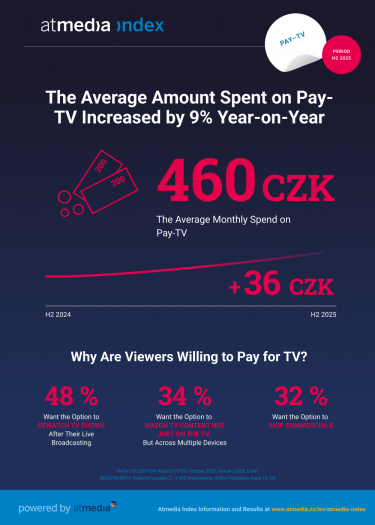
The average monthly amount that viewers spend on Pay-TV increased to CZK 460 in the second half of last year, representing a year-on-year increase of 9%. ‘Pay-TV prices have been rising over the long term, with a more significant turning point in 2024, when the price first exceeded the CZK 400 mark. At the same time, we are also seeing rising spending on paid VoD services,’ explains Michaela Suráková, Managing Director at Atmedia.
Despite gradual price increases, the popularity of Pay-TV among Czech viewers continues to grow. In the second half of last year, it was used by 67% of Czech TV viewers aged 15–69. The main driver of Pay-TV growth in recent years has been IPTV in particular, which–together with cable TV–is already used as the primary source of TV reception by more than half of viewers (54%). By contrast, the share of satellite reception has been declining in recent years, reaching a 13% share in the second half of last year.
More and more viewers use Pay-TV, particularly IPTV, because of the greater flexibility in how video content can be watched. Customers of TV operators most often mention catch-up viewing of programs. As a reason for paying for TV reception, this benefit is cited by 48% of Pay-TV users. More than one third of viewers (34%) appreciate the ability to watch television programs simultaneously not only on a TV set but also on other devices such as a PC, tablet, or mobile phone.
Viewers also value the ability to fast-forward through commercials (32%). ‘Some TV groups are limiting or completely blocking the ability to fast-forward ads, and others are considering this step. The reason is simple: when viewers skip commercials, television loses advertising revenue,’ says Michaela Suráková. Other frequently mentioned reasons include the ability to watch TV channels that are not available via free-to-air terrestrial broadcasting, access to video libraries, the option to watch content in HD quality, or access to exclusive sports content.
Pay-TV is most commonly used by TV viewers in larger cities. In municipalities with more than 100,000 inhabitants, significantly more viewers use IPTV or cable TV (64%) than in smaller towns and villages with up to 20,000 inhabitants (50%). Satellite reception, however, remains strongly represented among viewers in smaller towns, where it is used by 16% of viewers. ‘In smaller towns and municipalities, satellite remains an attractive option. It offers a stable signal, nationwide coverage, and for many households it is simpler than dealing with internet connection quality,’ adds Michaela Suráková.
Pay-TV is also most widespread among younger generations. Among viewers aged 15–34, nearly three quarters of TV viewers (74%) use Pay-TV. However, Pay-TV dominates across all age groups, including older generations. For example, it has a 63% share among viewers aged 45–69.
The survey research for Atmedia – sales house of thematic TV channels – was carried out by the ResSOLUTION research company using the CAWI method. The survey involved 4,052 respondents from the National Sample (online population aged 15–69). The survey took place in two waves from third to fourth quarter of 2025 (November 2–15, 2025, January 2–13, 2026).