Atmedia Index: One-Third of Czech TV Viewers Still Rely on Terrestrial Broadcasting


February provided the first comprehensive data including out-of-home television viewing in the Czech Republic. Out-of-home viewing accounted for 7% of the total time spent watching TV and made a significant contribution to the year-on-year growth in viewership. The highest shares were recorded by music and sports channels, further boosted this year by the Winter Olympic Games in Milan and Cortina d’Ampezzo. The findings are based on official television audience data highlighted by Atmedia, which represents twenty thematic TV channels on the Czech market.
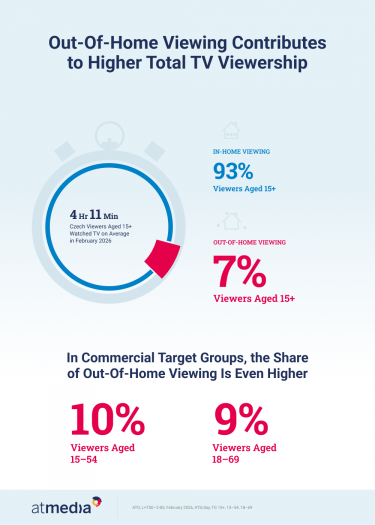
As of 1 February this year, a new standardised TV currency came into effect, which now includes out-of-home viewing. The Czech television market therefore has its first complete monthly data set covering out-of-home viewing. The data show that viewers aged 15+ spent an average of 4 hours and 11 minutes per day watching television in February. This represents a 10% increase compared to the same month last year. ‘The strong year-on-year increase was driven primarily by out-of-home television viewing. Even without it, however, TV viewership in February would still have grown compared to last year. The Winter Olympics also played a role, as they traditionally attract a wide range of viewers to television screens,’ explains Michaela Suráková, Managing Director at Atmedia. Out-of-home viewing accounted for approximately four-fifths of the year-on-year increase, while higher in-home viewing contributed the remaining fifth.[1]
Of the total 4 hours and 11 minutes, 17 minutes were attributed to out-of-home viewing, representing 7% of overall television consumption. In commercial target groups used by TV broadcasters to sell advertising space, the share of out-of-home viewing was even higher: 10% among viewers aged 15–54 and 9% among viewers aged 18–69. In both groups, overall television viewing also increased year on year, by 7% in the 15–54 target group and by 8% among viewers aged 18–69. ‘The highest share of out-of-home viewing can be seen among the youngest viewers under 34, who naturally spend more time outside their homes than older age groups,’ adds Michaela Suráková.[2]
The complete data for the first full month confirmed that out-of-home viewing is particularly significant for certain categories of thematic TV channels. ‘We are seeing significantly above-average figures for music channels. For example, Rebel from our portfolio recorded a 14% share of out-of-home viewing among viewers aged 18–69 during February,’ says Michaela Suráková. Selected documentary and children’s channels also reported high shares of out-of-home viewing in the same target group, including Discovery Channel and Disney Channel.[3]
Sports channels form a category of their own, as they are by nature widely watched outside the home, for example in restaurants, sports bars or during public screenings. This February was further influenced by the Winter Olympics, which consistently rank among the most-watched sporting events worldwide. This is also confirmed by the performance of Eurosport 1, the home broadcaster of the Olympic Games. ‘The Milan and Cortina d’Ampezzo Olympics reached a total of 1.7 million TV viewers aged 4+ on Eurosport 1, nearly three times more than the Winter Olympics in Beijing four years ago,’ states Michaela Suráková, adding that an important factor was the fact that viewers were able to watch the broadcasts live without any time difference.[4] Out-of-home viewing also made a significant contribution, accounting for 10% of Eurosport 1’s total viewership among viewers aged 18–69 in February.[5]