Atmedia Index: One-Third of Czech TV Viewers Still Rely on Terrestrial Broadcasting


Video content is more abundant than ever before, yet viewers’ time remains just as limited. The latest Atmedia Index research, regularly conducted by the advertising sales house Atmedia, therefore explored how Czechs aged 15–69 combine viewing TV channels and streaming services, how they choose content, and what motivates them. The results revealed that Czech viewers can be divided into seven distinct types and showed that video consumption today is not a matter of choosing one over the other, but rather of smartly combining platforms.
The range of video content continues to expand. Viewers can choose from dozens of TV channels, a wide variety of streaming services, YouTube or social media. ‘There is more available content than ever before, while viewers still have the same amount of time. That is why we wanted to understand which platforms Czech viewers spend their time with, how they decide what to watch, and what their preferences and motivations are,’ says Michaela Suráková, Managing Director of Atmedia, commenting on the latest Atmedia Index results. Some of these findings were presented for the first time at the Forum Media 2025 conference under the title The 7 Faces of the Czech Viewer. ‘We sometimes hear that younger generations today watch only streaming services, while older generations watch only television. That is why we wanted to look at the facts,’ explains Michaela Suráková, outlining the main motivation behind the research.
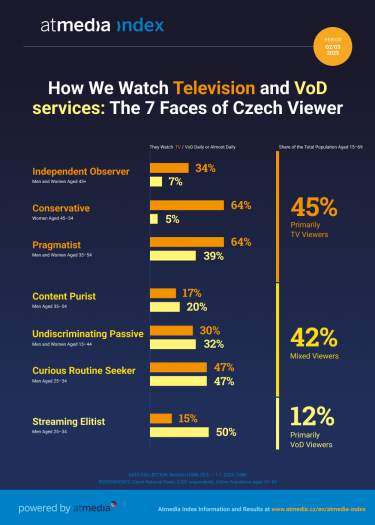
Based on the intensity of viewing TV channels and VoD services, as well as viewers’ behaviour and attitudes, the Atmedia Index research identified seven segments of Czech viewers. The first segment consists of Streaming Elitists – viewers aged 25–34 who show a strong preference for VoD services. Exactly half of them watch VoD services daily, while only 15% watch TV broadcasting on a daily basis. ‘Streaming Elitists unsurprisingly watch almost exclusively streaming services. They switch on television mainly to stay informed. However, their share of the Czech population amounts to just 12%,’ points out Michaela Suráková.
In contrast to these viewers, there are three further segments that tend to favour TV broadcasting: Independent Observers, Conservatives and Pragmatists. Together, they account for 45% of the Czech population aged 15–69. What these three segments have in common is that they all spend more time watching TV channels than streaming services, differing only in frequency. While 34% of Independent Observers watch TV channels daily, the figure reaches 64% among both Conservatives and Pragmatists. Independent Observers are aged 45+ and hardly watch streaming services at all. Conservatives are predominantly women aged 45–54 who have also not yet embraced streaming services. By contrast, Pragmatists – the youngest of these groups (35–54) – have already adopted streaming services, with 39% of them watching VoD services on a daily basis.
The final three viewer segments are Content Purists, Undiscriminating Passives and Curious Routine Seekers. ‘What makes this group of viewers interesting is that they watch TV broadcasting and streaming services with the same frequency. They differ only in how often they watch,’ explains Michaela Suráková. The lightest consumers are Content Purists – predominantly men aged 35–54 – who spend relatively little time watching any kind of video content. Fewer than one fifth of them watch either streaming services or TV channels on a daily basis. Stronger consumers are Undiscriminating Passives, viewers aged 15–44, around one third of whom watch TV and VoD services every day. The heaviest consumers are Curious Routine Seekers, mostly men aged 25–34. They look for content across both TV channels and streaming services, with 47% watching both platforms daily. Together, Content Purists, Undiscriminating Passives and Curious Routine Seekers account for 42% of the Czech population.
The Atmedia Index research, in addition to examining the frequency of TV channel and streaming service usage, also focused on viewers’ behaviour and attitudes. ‘From this perspective, viewers like Content Purists, Undiscriminating Passives and Curious Routine Seekers are particularly interesting. These groups are similar in age and split their time equally between TV channels and streaming services. However, they differ in their behaviour and attitudes,’ notes Michaela Suráková.
While Content Purists primarily seek news programmes on TV channels, followed by films and documentaries, Undiscriminating Passives and Curious Routine Seekers mainly watch films and series on television. All of these segments primarily watch TV at home, but Curious Routine Seekers also watch TV in pubs or at public screenings — in addition to films and series, they also seek sports broadcasts. All segments agree that they watch TV to stay informed. While Curious Routine Seekers mention their daily routine as the second reason, Undiscriminating Passives mention the opportunity to relax.
The Atmedia Index research has shown that Czech viewers are highly diverse and often do not distinguish between TV channels and streaming services. ‘It is not about choosing one over the other. Only around one tenth of viewers watch streaming services exclusively. Almost half of viewers primarily watch TV channels but are gradually finding their way to streaming services. The remaining two fifths watch both streaming services and TV channels with the same frequency,’ summarises Michaela Suráková, adding that viewers choose individual platforms depending on their current mood, preferences or motivation. For some, television is mainly a source of information, while for others it is also a centre of entertainment and relaxation. Some viewers watch TV almost exclusively at home, while others also watch it in pubs or when visiting friends. And while streaming services are still a marginal option for some, for others they are a natural part of everyday life.
The research for Atmedia, the media representative for thematic television channels, was conducted by the research agency ResSOLUTION using the CAWI method. A total of 2,002 respondents from the Czech National Panel (an online population aged 15–69) participated in the survey. Data collection took place during the period 20th June – 1st July 2025.