Atmedia Index: One-Third of Czech TV Viewers Still Rely on Terrestrial Broadcasting

In a time when viewers can choose from dozens of TV channels and hundreds of titles on streaming platforms, deciding what to watch is becoming increasingly difficult. An overly broad offer can lead to the so-called paradox of choice – a situation in which too many options make decision-making harder and reduce overall satisfaction. TV viewers experience this as well: 46% say they regularly spend too much time selecting what to watch. On streaming services, the issue is even more common, affecting as many as 60% of users.
‘Even within Free-to-Air broadcasting alone, viewers have access to dozens of TV channels, with Pay-TV operators offering dozens more. This offer is now so extensive that some viewers spend more time choosing a programme than they would like,’ says Michaela Suráková, Managing Director of Atmedia, which regularly conducts the Atmedia Index survey mapping the Pay-TV market and streaming services. According to the latest results, 46% of TV viewers state that selecting a programme on television regularly takes them longer than they would prefer – either every time or in roughly half of all cases.
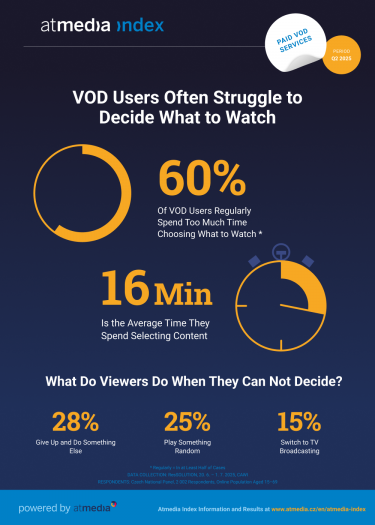
Users of streaming services face an even greater dilemma when deciding what to watch. As many as 93% of them spend a longer time choosing at least occasionally, with 60% experiencing this in most cases or around half the time. ‘While TV channels – even with new options such as delayed TV viewing – offer viewers a linear programme schedule, streaming platforms provide vast libraries of titles from which viewers must choose themselves,’ explains Michaela Suráková. According to the Atmedia Index research, the time spent choosing is far from negligible – on average, it amounts to 16 minutes, and in some cases even up to 30 minutes. ‘The act of deciding what to watch is becoming a significant part of the user experience. If viewers struggle to find something that interests them, it can lead to frustration or even cause them to give up watching altogether,’ she adds.
This is also confirmed by the results of the Atmedia Index research. When users of streaming services spend too much time choosing what to watch, some ultimately give up and switch to another activity. This is the case of 28% of them. Others decide not to spend any more time searching and play something random that happens to catch their attention – 25% of users take this approach. Some try their luck elsewhere: 15% switch to TV broadcasting, and 9% move to a competing service. Recommendations also play a role in these situations. According to the research, 15% of users look for inspiration online, while 6% rely on tips from friends and acquaintances. ‘The current challenge for steaming platforms – and of course for TV channels as well – is not only to attract viewers, but also to keep their attention for as long as possible. Content must be not only high-quality, but also relevant and easily accessible,’ says Michaela Suráková.
The results of the Atmedia Index research show that spending a long time choosing content – and the frustration that comes with indecision – often leads viewers either to give up watching altogether or to switch between platforms. ‘In an environment oversaturated with content, TV channels continue to hold a strong position. Thanks to curated content and clear programme schedules, they help viewers navigate the offer,’ says Michaela Suráková. This trend is also reflected in the rise of so-called FAST channels, which combine the advantages of streaming services with linear broadcasting.
The research for Atmedia, the media representative for thematic television channels, was conducted by the research agency ResSOLUTION using the CAWI method. A total of 2,002 respondents from the Czech National Panel (an online population aged 15–69) participated in the survey. Data collection took place during the period 20th June – 1st July 2025.