Atmedia Expands Its Portfolio to 22 Channels with the Addition of Three FILMBOX+ Movie Channels
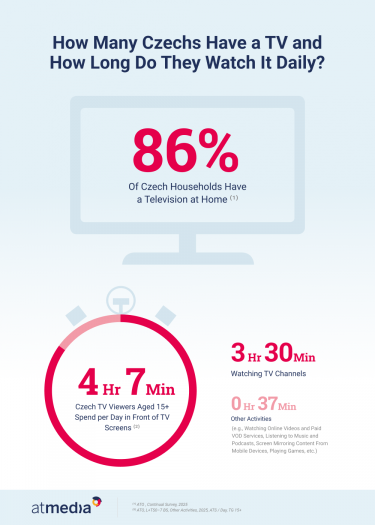
Television remains a key part of Czech households, with 86% of homes owning a TV set. It continues to serve as the central hub for entertainment and relaxation at home. Although people are increasingly using the largest screen in their household for a wider range of activities, from watching online videos and listening to music to gaming, television content remains the most frequently watched type of content across all age groups. These findings are based on official TV audience measurement data presented by Atmedia, which represents 20 thematic TV channels on the Czech TV market.
The data also show that viewers aged 15+ spend an average of 4 hours and 7 minutes per day in front of a television screen. Watching television channels accounts for 85% of this time, which corresponds to around three and a half hours per day. The remaining 15% is spent on other activities, which viewers engage in for an average of 37 minutes per day.[1] These activities mainly include watching online video platforms (such as YouTube) or VOD services (such as Netflix, HBO Max, and Disney+). In some households, televisions are also used for listening to music and podcasts, mirroring content from mobile devices, or playing games.[2]
The use of television for activities beyond traditional viewing has been steadily increasing. While ten years ago these uses were rather marginal, today more than one-quarter of viewers use their TV every day for activities other than watching television channels. The amount of time spent on these activities has also grown significantly. In 2015, viewers spent an average of 8 minutes per day on them; five years later, this increased to 21 minutes, and today it has reached 37 minutes per day.[3] ‘Despite this development, these activities still represent only 15% of the total time people spend in front of a television screen. Television broadcasting therefore remains the main purpose for which people use their TV sets,’ says Michaela Suráková, Managing Director of Atmedia.
The shift towards using televisions for other activities is most visible among younger age groups. For example, viewers aged 25–34 spend an average of 55 minutes per day on activities other than watching television channels, representing 40% of their total screen time. A similar trend can be observed among viewers aged 35–44, where other activities account for approximately one-third of the time spent in front of the TV. As viewers get older, the share of these activities decreases. Among people aged 45–54, they represent 18% of total TV screen time, while among viewers aged 55+, they account for only 8%.[4]
The growing use of televisions for additional activities is closely linked to technological development, particularly the increasing availability of internet-connected TVs. Their number has increased significantly: while in 2020, 35% of TV households had an internet-connected television, this figure had already reached 59% last year.[5] ‘Thanks to internet connectivity, the television has evolved into a fully-fledged multimedia device. In addition to linear broadcasting, it offers a wide range of applications and functions, which naturally encourages people to use it for other activities as well,’ adds Michaela Suráková.
The length and type of content also play an important role. According to the latest data, viewers prefer watching films and series on a large screen, which provides a better overall viewing experience. ‘79% of Czechs watch series and other programmes lasting up to one hour on a television, while for films and programmes longer than one hour, this figure rises to 86%. In contrast, short videos lasting only a few minutes are mainly watched on smartphones,’ concludes Michaela Suráková.[6]